Solar Home Introduction
|
 |
|
TO FIGURE
YOUR POWER REQUIREMENTS, you need to do some homework for us--everyone's
power consumption differs! Without your load information, we
cannot specify what components it will take for your system.
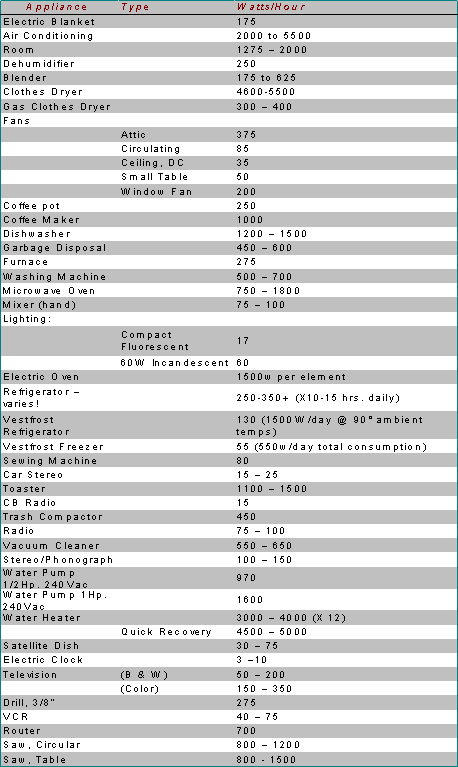
These items and
appliances are listed with their hourly power requirements in terms of
watts. Figure out what you need, and multiply that by your hours
of usage in a day. WE'RE TRYING TO COME UP WITH THE TOTAL
WATT-HOURS PER DAY YOU
NEED. For example, a 300 watt (120V AC) load for ˝ hour consumes
150 watts--or for 3 hours would come to 900 watt-hours needed for this
item. If you cannot find your specific load requirement on this
list, look for an electrical rating sticker on your unit, or contact the
manufacturer.
*** AMPS X
VOLTS = WATTS ***
For
example, if it says 2 amps (@ 120V), the load is 240 watts per hour. Or,
a 4 amp load for 8 hours a day would come to 3840 watt-hours needed per
day. If you already know your daily power requirements,
click on "Map &
Insolation Data" to get an idea of the costs for your
system. If you need some assistance, click on the load
evaluation
button which gives you an outline/worksheet to help ascertain your power
requirements.
YOU CAN USE YOUR UTILITY
BILL AS A GUIDE--usually
the number of kilowatt hours used per month is listed (a kilowatt-hour
is 1000 watt-hours, a kilowatt is 1000 watts). If you divide the
number of kilowatt-hours used by the number of days of the billing
period, then multiply that number by 1000, you'll come up with the
average number of watt-hours per day you use. The amount of power
you use may shock you! This is why, if you're considering going
off-grid, it's crucial that you
reduce your electrical loads as much as possible
by using energy efficient lighting,
refrigeration
units, and by
converting your heating loads to
natural
gas, propane or
wood. A photovoltaic (PV) powered home might look like a
conventional home, but its electrical requirements are significantly
reduced by the use of energy efficient appliances, and by using gas for
all heating loads. |
|
|
POWER
USAGE: add up your loads X the number of hours of usage
Unit/Loads
Watts used per hour (watt-hours) |
|
|
 |
|
|
Remember, if you're only using a given load for a part of an hour,
divide that hourly total by the percentage of the hour you're using that
load. A 300 watt per hour load for ten minutes equals 50 watt-hours
total. The electrical load
information is most crucial; without
this information, there is a risk of under- or over-sizing the
system requirements. We don't want to sell you something that
doesn't meet YOUR SPECIFIC power requirements. If you have
questions or need help figuring out your loads, please do not hesitate
to e-mail us or call
toll-free 1(877)OASISPV or 1-(877)OASISMT, or use the load
evaluation button and form to help figure your power usage.
After you have ascertained your load information, multiply the
watt-hours needed per day by 1.3, to account for battery and inverter
inefficiencies. THIS IS THE ACTUAL POWER YOUR SYSTEM NEEDS TO BE MAKING
TO MEET YOUR LOAD REQUIREMENTS. Batteries and inverters are not 100%
efficient, so we refer to this as the "load correction
factor". With this figure, we can determine what size system,
and what components, are needed to meet your power requirements.
Click on the insolation
map to determine the
amount of sun-power available for your area.
|
|
|
IF YOU KNOW
WHAT COMPONENTS YOU'RE LOOKING FOR…
PLEASE
JUMP TO OUR "COMPONENTS"
PAGE OR OUR "PRICING"
PAGE!!!
|
WHAT'S NOT SMART TO DO WITH
SOLAR….
There are definitely
electrical loads that are NOT at all cost-effective to power with solar
electricity . These include: making heat in any way (space heating,
water heating, clothes drying, cooking) and other large loads (air
conditioning, refrigeration). It is generally MUCH more cost-effective
to power these loads with wood, propane, or natural gas. NOTE:
there are some energy efficient
refrigeration units available that are reasonably powered by
photovoltaics. Be certain you know your manufacturer's (accurate)
specifications. The wattage demands for refrigerators and freezers
may run from 540 watt-hours per day (for an efficient unit) to upwards
of 8500 watt-hours per day. That's a BIG difference! We have
additional information on energy
efficient and propane
refrigeration units |
|
|
SUGGESTED
SYSTEMS - Map &
Insolation Data |
After you have ascertained your "adjusted watt-hours per day"
required , using the power load information, you can get an idea
of what your power requirements will cost when you click on our Map
& Insolation data in the U.S. By selecting
your zone location, we can determine the amount of sunlight that is
provided to your area--and, with your load information, determine what
components are necessary for your system.
|
|
|
We've shown some suggested systems here, how much power they will
provide, and their cost. These are merely guidelines to assist
you; we design power systems specifically to meet YOUR power needs.
You may order our Design Guide and Product Catalog on disk for $10.00,
or get on
our mailing list by calling 1-877-627-4768 or send us an email with your
request by clicking
here. |
|
|
|
|
|
|